
How to Label Squeeze Bottles in a Commercial Kitchen: 7 Methods Compared
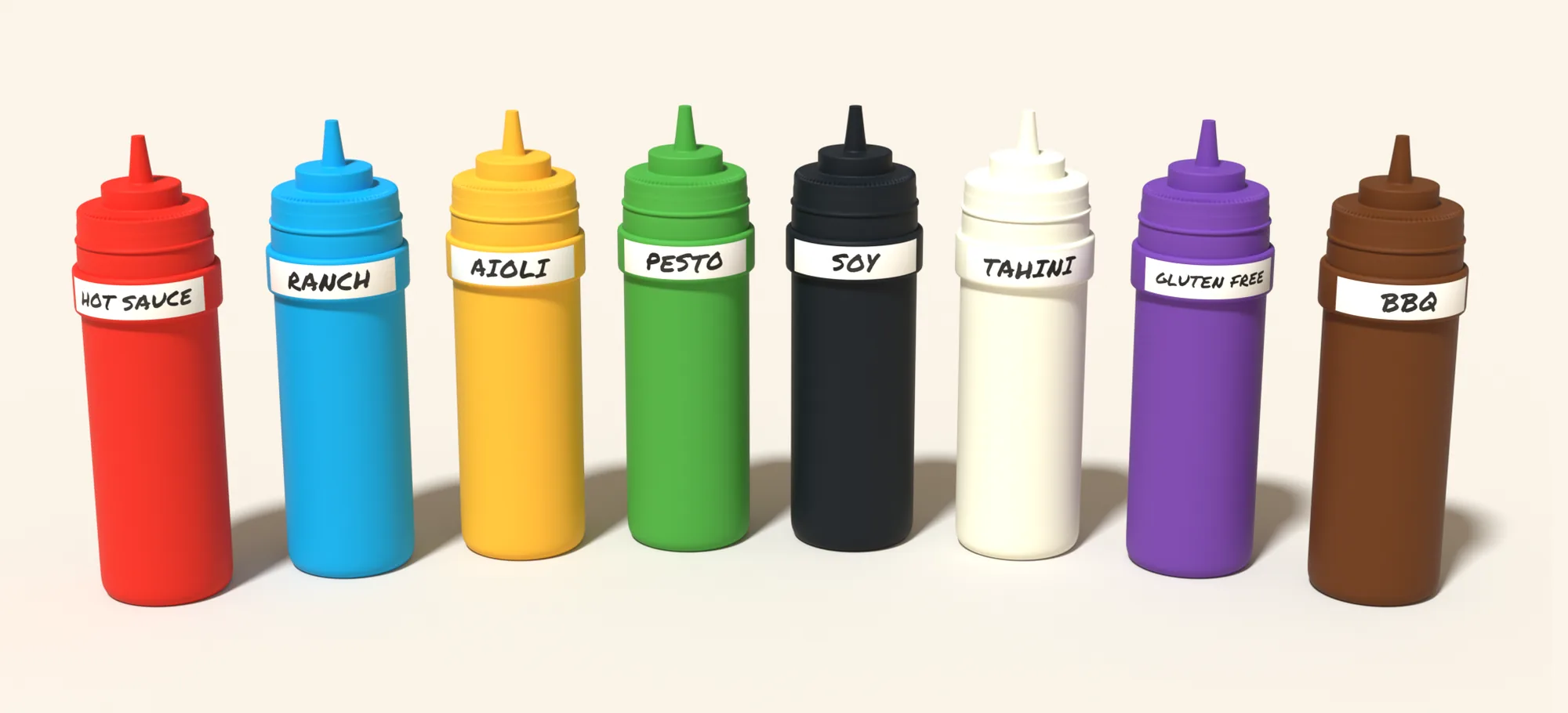
Every squeeze bottle on the line needs the name of what is inside it, written where a cook can read it mid-service. Masking tape and a marker is the usual start, and the method you redo most often. Here is what the health code asks for, how seven methods compare, and how to pick one.
Do squeeze bottles have to be labeled?
In most US kitchens, yes. The FDA Food Code is the model that state and local health codes are built on, and section 3-302.12 covers it:
“Except for containers holding food that can be readily and unmistakably recognized such as dry pasta, working containers holding food or food ingredients that are removed from their original packages for use in the food establishment, such as cooking oils, flour, herbs, potato flakes, salt, spices, and sugar shall be identified with the common name of the food.”
A squeeze bottle of ranch is a working container. Three pale sauces in three identical bottles are not “readily and unmistakably recognized.”
Two more rules can land on the same bottle:
- The date. Under section 3-501.17, refrigerated, ready-to-eat food that needs temperature control and is held for more than 24 hours is marked with the day it must be used or discarded: no more than 7 days at 41°F (5°C) or below, with the prep day counted as Day 1. Many house-made sauces and dressings fall here.
- Chemicals. Section 7-102.11 asks for the common name on working containers of cleaners and sanitizers too.
Your state or county adopts its own version of the Food Code, so confirm the local wording with your inspector.
What a squeeze bottle label has to survive
A squeeze bottle is a hard place for a label. It sits in a cold well, sweats, gets grabbed with wet and oily hands, and goes through the dish machine at close. A method that works has to:
- Stay readable through service.
- Stay on a cold, wet, greasy bottle.
- Survive the wash, or come off clean before it.
- Change when the contents change.
- Leave nothing behind on the bottle.
Seven ways to label a squeeze bottle, compared
| Method | Typical cost | In the dish machine | When the contents change |
|---|---|---|---|
| Masking tape and marker | About $2.59 a roll | Not built for it. Peel it first | Re-tape and rewrite. Often leaves adhesive residue |
| Dissolvable labels | About $0.10 a label | Washes away by design | New label every time. No residue, per the listing |
| Adhesive vinyl or laminated labels | Varies | Depends on the adhesive and the wash | Peel, reprint and restick. Can leave adhesive residue |
| Marker straight on the bottle | The marker | Wears with washing | Scrub off the old name first. Traces can stay |
| Color-coded caps | Varies by bottle system | Fine | Swap the cap |
| Pre-printed silicone bands | $3.99 each, $1.99 in lots of 12 | Dishwasher safe, per the seller | Buy a different band. No adhesive |
| Writable silicone bottle bands | $1.33 to $2.75 per band | The band is dishwasher safe at commercial temperatures | Wipe with isopropyl alcohol and rewrite. No adhesive, no residue from the band |
Prices are the listed prices on November 29, 2026. Tape, dissolvable labels and pre-printed bands are from a US restaurant-supply store, linked in the references below. Writable bands are the current Kitchen Bandits packs.
1. Masking tape and marker
The default in most kitchens, because the roll is already there. A 60-yard (54.9 m) roll of general purpose masking tape lists at $2.59, so the material cost per label is close to nothing. The real cost is the redo. That roll lists a service range of 60 to 150°F (16 to 66°C), and a cold well holds food at 41°F (5°C) or below. Tape lifts on cold, wet bottles, and whatever survives service has to be peeled before washing, often leaving adhesive behind. More in why masking tape doesn’t work.
2. Dissolvable labels
Labels that dissolve in water. One common 2 x 3 inch (51 x 76 mm) roll lists at $24.99 for 250 labels, about $0.10 each, and the listing says it dissolves in any water temperature in as little as 30 seconds. That is the right behavior for a dated prep container that gets washed every day. On a squeeze bottle it means a new label, written by hand, after every wash.
3. Adhesive vinyl or laminated labels
Printed labels look sharp and suit a bottle that holds the same thing all year. The weak point is the adhesive. Heat, detergent and a flexing bottle all work on it, and when the menu changes the label has to be peeled and reprinted. See why adhesive labels can peel in commercial dishwashing.
4. Marker straight on the bottle
Fast and free. It also commits the bottle. The writing wears with washing and handling, and the old name has to be scrubbed off before a new one goes on.
5. Color-coded caps
Colored caps sort bottles at a glance: one color per station, or one color kept for allergen-aware prep. They pair well with any method here. On their own they do not put a name on the bottle, and the Food Code asks for the common name.
6. Pre-printed silicone bands
A silicone band with the name printed on it, stretched over the bottle. No adhesive. One restaurant-supply house brand lists at $3.99 a band, or $1.99 in lots of 12, sized to the bottle and sold as dishwasher safe. If your ranch is ranch every day of the year, this is a clean answer. The limit is the fixed text: a special, a seasonal sauce or a new prep item needs a band you do not own yet. Compare the two in pre-printed vs writable silicone bands.
7. Writable silicone bottle bands
A silicone band with a white writing box. Write the name with a black oil-based paint marker. When the contents change, wipe the writing off with isopropyl alcohol and write the new one. The band grips by tension, so there is no adhesive and no residue from the band, and it is dishwasher safe at commercial temperatures.
The honest limits: the marker is a separate purchase, changing the name takes a wipe with alcohol, and a faint shadow of the old writing can remain. That is cosmetic. Let fresh writing dry before the bottle goes back into service, and touch it up when it has worn.
Which method fits your kitchen
- The contents never change: pre-printed silicone bands, or a printed label you are willing to replace.
- The contents change with the menu, the season or the shift: writable silicone bottle bands.
- You date containers that get washed every day: dissolvable labels for the containers. Keep the bottle’s name on something that stays.
- You sort by station or keep allergen-aware bottles apart: add a color, by cap or by band, on top of the name. A color supports your allergen process. It does not replace it.
- You open next week with nothing on hand: tape and a marker will get you through. Plan the replacement.
If you go with writable bands: size, marker and price
Kitchen Bandits makes writable silicone bottle bands in four sizes and eight colors. They are food-grade, BPA-free silicone, heat-safe to 450°F (232°C) and, as a separate fact, dishwasher safe at commercial temperatures.
Size by diameter, not by ounces. Measure straight across the outside of the bottle where the band will sit.
| Band size | Fits bottle diameter | 8-pack, one color | 8-pack, multicolor |
|---|---|---|---|
| Small, 1 3/4″ (45mm) | 1.77–2.17 in (45–55 mm) | $16.97 | $19.97 |
| Medium, 2 1/8″ (55mm) | 2.17–2.76 in (55–70 mm) | $16.97 | $19.97 |
| Large, 2 3/4″ (70mm) | 2.76–3.35 in (70–85 mm) | $16.97 | $19.97 |
| X-Large, 3 3/8″ (85mm) | 3.35–4.13 in (85–105 mm) | $18.97 | $21.97 |
A 24-pack runs $31.97 to $37.97 depending on size and color, which brings a band down to between $1.33 and $1.58. A 32-pack with all four sizes is $49.97 in one color or $54.97 in multicolor. Prices are in USD.
Marker. Use a black oil-based paint marker. Markers are not included in the packs yet. Colored oil-based ink and permanent marker can leave a more visible shadow. See the marker guide.
Start with one station. An 8-pack covers eight bottles. Measure one bottle with the fit tool, band one station, and add the next once the first has earned it. One bottle size across the line: a 24-pack. Mixed bottle sizes: the 32-pack has eight bands in each of the four sizes.
Kitchen Bandits bands are sold on Amazon.com 🇺🇸. Choose your size, pack and color and the page links to the exact Amazon listing with its current availability.
Questions kitchens ask
What is the best way to label squeeze bottles in a restaurant?
It depends on whether the contents change. For a bottle that holds the same sauce all year, a pre-printed silicone band or a printed label is enough. For bottles that change with the menu, a writable silicone bottle band and a black oil-based paint marker let you rewrite the name without tape or adhesive.
Do squeeze bottles need to be labeled for a health inspection?
Under FDA Food Code section 3-302.12, working containers of food removed from the original package must be identified with the common name of the food, unless the food is unmistakably recognizable. Most sauces in squeeze bottles are not. States and counties adopt their own version of the code, so confirm the local wording with your inspector.
What should I write on a squeeze bottle?
The common name of what is inside, such as ranch or simple syrup. If the food is refrigerated, ready-to-eat, needs temperature control and is held more than 24 hours, FDA Food Code section 3-501.17 also calls for the day it must be used or discarded: no more than 7 days at 41°F (5°C) or below, counting the prep day as Day 1.
Can silicone bottle bands go through a commercial dishwasher?
Kitchen Bandits silicone bottle bands are dishwasher safe at commercial temperatures. The silicone is separately heat-safe to 450°F (232°C). The band grips the bottle by tension, so there is no adhesive.
What marker do you use on silicone bottle bands?
A black oil-based paint marker, sold separately. Markers are not included in Kitchen Bandits packs yet. To change the name, wipe the writing off with isopropyl alcohol and let the band dry. A faint shadow of the old writing can remain. See the marker guide.
What size band fits my squeeze bottle?
Measure straight across the outside of the bottle where the band will sit. Kitchen Bandits bands come in four sizes that cover bottle diameters from 1.77 to 4.13 inches (45 to 105 mm). Size by diameter, not by ounces. The fit tool turns a measurement into a size.
How much do writable silicone bottle bands cost?
A Kitchen Bandits 8-pack is $16.97 in one color or $19.97 in multicolor for the three smaller sizes, which is $2.12 to $2.50 per band. 24-packs start at $31.97, or $1.33 per band. Prices are in USD.
Where can I buy writable silicone bottle bands?
Kitchen Bandits silicone bottle bands are sold on Amazon.com 🇺🇸. Choose the size, pack and color on the products page and it links to the exact Amazon listing with its current availability.