
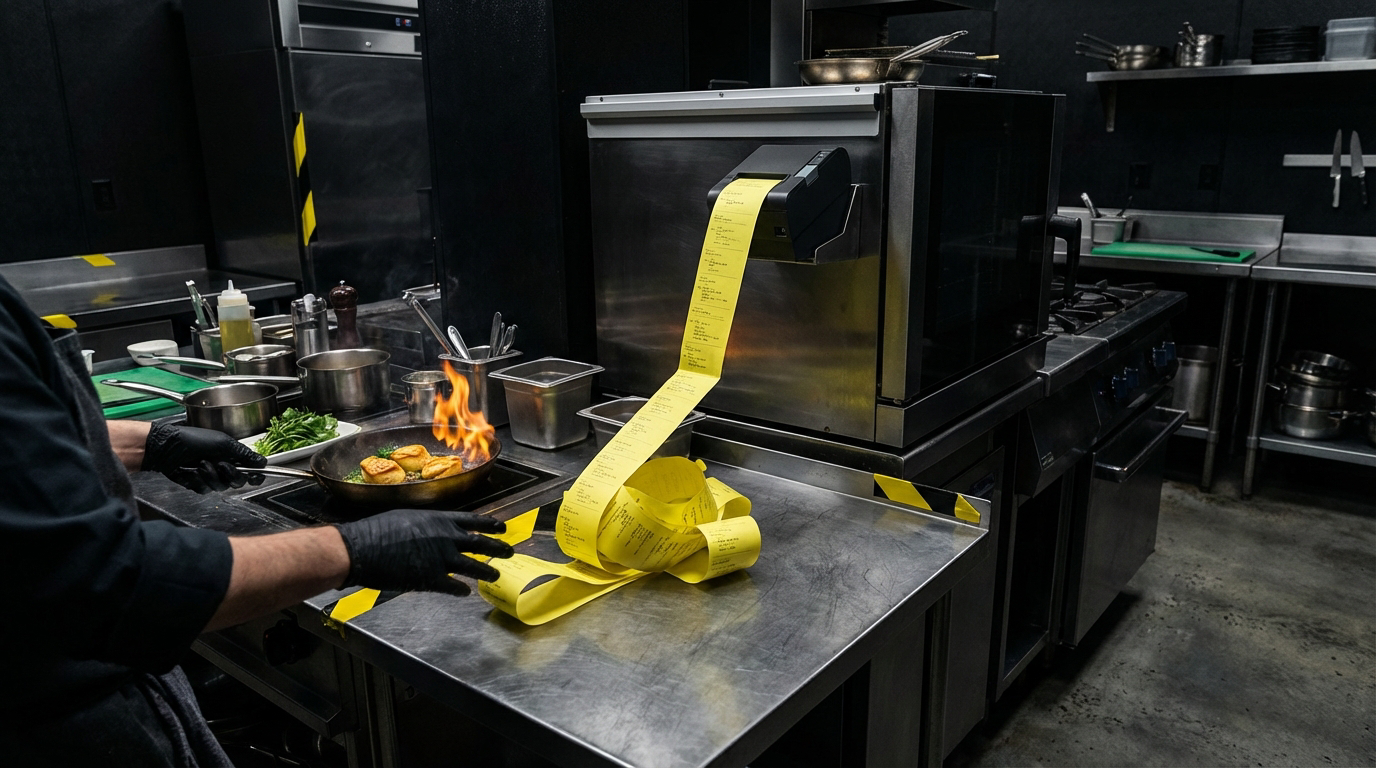
A thread on ChefTalk pulled the kind of responses that only come from people who have lived it. A culinary student, one year into a career change, got moved from pantry to garde manger lead and thrown onto sauté cover — 3 stations worth of responsibility with almost no formal training. The question was simple and desperate: how do you keep track of orders when the printer won’t stop and the chef is calling 3 tickets ahead of the one you’re still finishing?
Every cook who has worked a busy line knows exactly where that person is standing. Not metaphorically. Physically. Feet planted, hands moving, brain three steps behind. The printer keeps going. The chef keeps calling. And you’re staring at a rail of tickets that stopped making sense two minutes ago.
What makes this worse is that it compounds. Miss one ticket and the next three stack on top of it. Now you’re not just behind — you’re guessing. Was the fish for table twelve or fourteen? Did you already drop the calamari? The fryer timer is beeping but you can’t remember what you put in there. Meanwhile the chef has moved on to ticket seven and you’re mentally stuck on ticket four. The longer it goes, the deeper you sink. Cooks call it the weeds. When you’re truly in it, every decision takes twice as long because you’re spending half your processing power just trying to figure out where you are.
The part that nobody talks about is that this isn’t a talent problem. It’s a systems problem. The thread made that clear. One commenter put it bluntly: if the cook is failing, the training has failed. Another pointed out that working 3 days a week — which the original poster was doing alongside culinary school — makes real flow almost impossible. Muscle memory on a station needs roughly 40-60 hours of repetition before the movements become automatic. At 3 shifts a week, that’s over a month before you stop consciously thinking about where things are. Until then, every service is a pop quiz on a layout you haven’t memorised yet.
Kitchen Bandits load model (original analysis)
Using the thread’s own numbers, we scored this station as a high-load scenario. The cook was covering 3 stations, while calls came 3 tickets ahead, and the fryer lane carried roughly 6-15 bottles. That yields a live decision surface of about 54-135 concurrent item-state checks per service cycle (3 x 3 x 6-15). Our takeaway: reduce interpretation steps before you increase speed expectations.
The most useful advice in the thread came from a cook who had clearly been through the same thing. Physical memory cues. When the chef calls halibut, you pull a piece of halibut out of the lowboy and set it where you can see it. Not to cook it yet — just to mark the ticket. Pie pans, ramekins, small containers set in a row along your station, each one representing an active ticket. You build a physical queue that mirrors the rail so you don’t have to keep re-reading it. Your eyes do the tracking instead of your brain.
A sous chef in the same thread added the timing principle that separates a working line from a drowning one: build from slowest to fastest. Everything that takes the longest goes down first. A twelve-minute braise, an eight-minute steak, and a three-minute fryer drop from three different tickets all get staged by when they need to hit the pass — not by which ticket printed first. You’re not cooking in ticket order. You’re cooking in time order. Once that clicks, the rail stops being a wall of paper and starts being a schedule.
But all of this falls apart if your station isn’t set up to support it. Mise en place gets talked about like it’s a habit. It’s not. It’s a system. Every bottle, every container, every tool has a fixed position that doesn’t change between services. The deep fryer station this cook was covering probably had 6-15 squeeze bottles that all look identical when you’re moving fast. Grab the wrong one and you’ve killed a dish. Grab the allergen-wrong one and you’ve created a liability.
This is where the invisible work happens. The stuff nobody notices until it fails. A station where every bottle has a fixed spot and a visual identifier — not a label you have to read, but something you can clock from 3 feet away while your hands are doing something else — removes an entire layer of decisions from service. You’re not reading. You’re not decoding handwriting. You’re seeing a color and reaching for it. That’s the difference between a system that works at 30 covers and one that holds at 150.
The cook in that thread was told to stop feeling like a failure. Good advice. But the better advice came from the people who said: build a station that does the remembering for you. Set your physical cues. Lock your layout. Make the visual system so obvious that your body can run it while your brain handles the tickets. Because the printer is never going to slow down. The chef is never going to stop calling. The only variable you control is how much thinking your station demands from you during service. The answer should be as close to zero as possible.