How should I measure a bottle?
Measure straight across the outside of the bottle body and check where the band will sit. Enter the measurement in the tool on this page. Don't guess from ounces or bottle height.
 KITCHEN
Product guide
Measure straight across the outside of the bottle body.
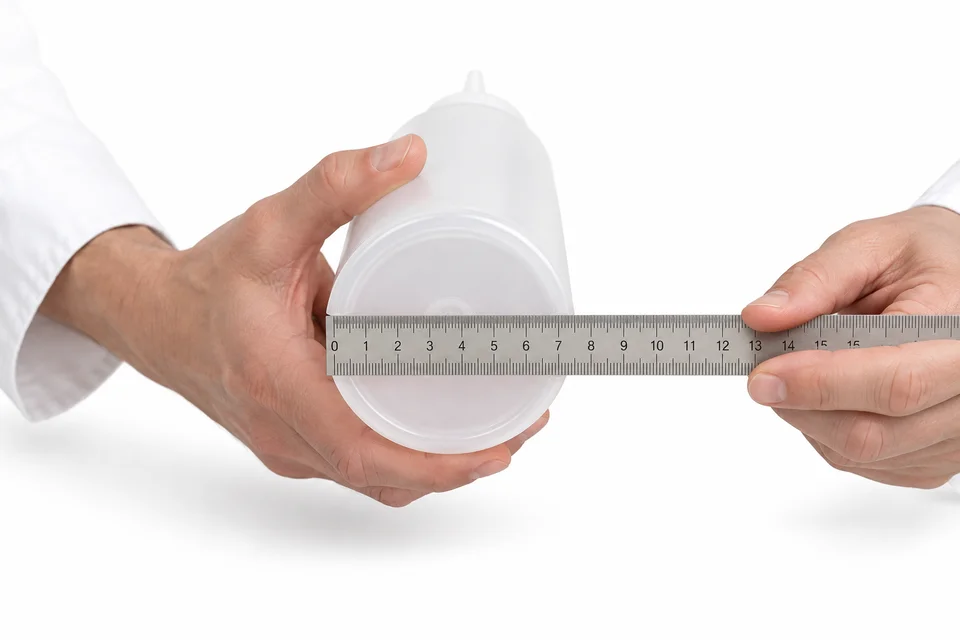
Measure straight across the centre, from one outside edge of the bottle body to the other. Skip the neck, cap and recessed inner base.
Check the part where the band will sit too. If the bottle tapers or has an unusual shape, ask us before ordering.
| Band | Inches, approx. | Millimetres |
|---|---|---|
| S · Small | 1.77–2.17 | 45 to under 55 |
| M · Medium | 2.17–2.76 | 55 to under 70 |
| L · Large | 2.76–3.35 | 70 to under 85 |
| XL · X-Large | 3.35–4.13 | 85 to 105 |
Inch conversions are rounded for display. If your inch entry matches a rounded size limit, enter your measured millimetres to confirm. At 55, 70 or 85 mm, use the next size range.
Measure straight across the outside of the bottle body and check where the band will sit. Enter the measurement in the tool on this page. Don't guess from ounces or bottle height.
Measure your bottle first. The tool suggests a size from its outside diameter; bottle volume alone cannot tell you which band fits.
Use the actual diameter, not the product description. If a bottle sits near a transition point, test one band before ordering the station set.
Choose an 8-pack or 24-pack in your measured size, or a 32-pack with eight bands in each of the four sizes. Check the selected pack on Amazon for current availability.