
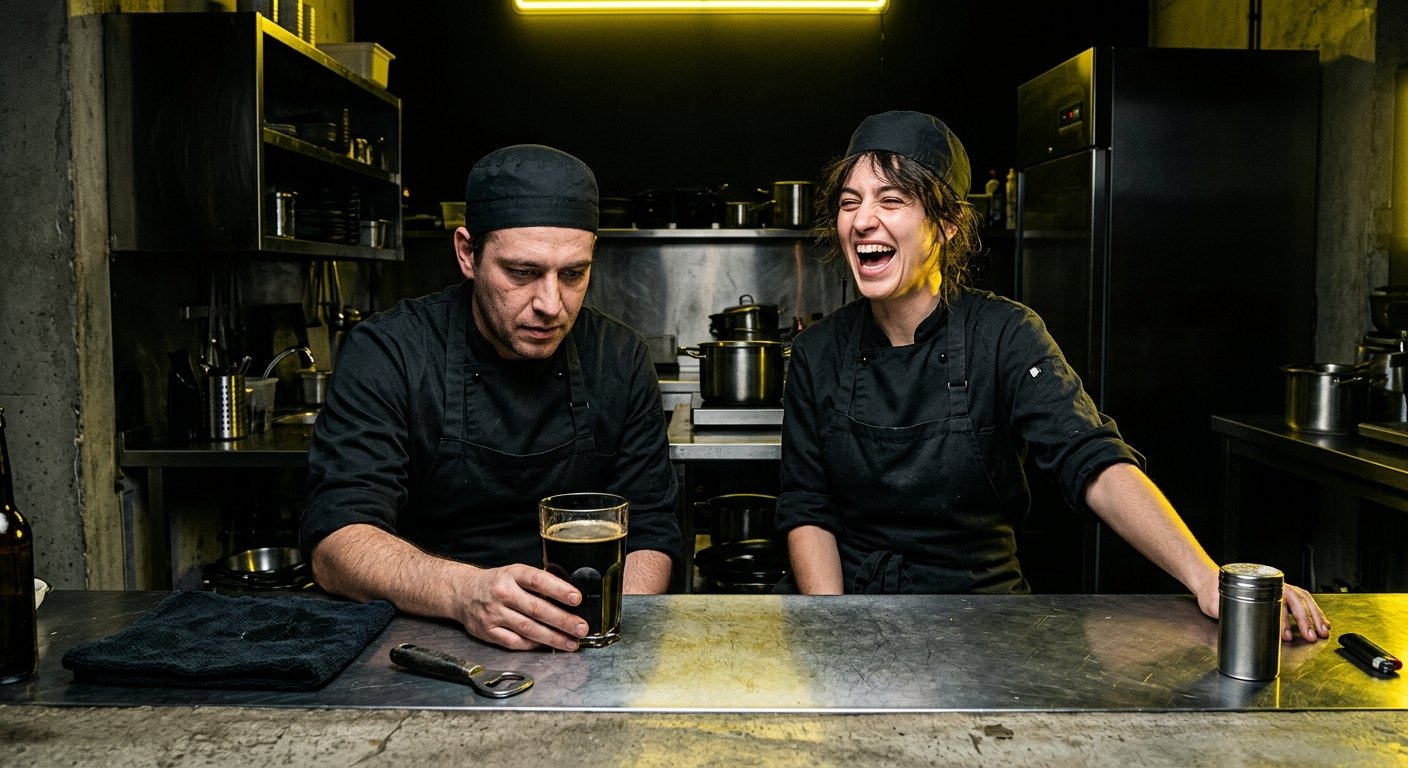
During service, you are a different person.
You are fast. You are precise. You call out every ticket. You know exactly where every pan is, what temp everything’s at, and who’s about to fall behind before they know it themselves. You don’t second-guess. You don’t hesitate. You just move.
Then service ends.
And suddenly you’re standing at a bar at midnight, still in your blacks, and you can’t decide what to drink. You walked out like you owned the room. Now you’re staring at the taps like they’re a written exam.
The whiplash is real. And it’s not a character flaw.
The kitchen runs on urgency. Everything is high-stakes, right now, no room for error. That state of hypervigilance isn’t something you can just switch off at the end of a shift. Your nervous system doesn’t have a clock-out function.
So you go home wired. Or you go to the bar wired. You’re funny and loud and then suddenly you’re not. You’re the best company in the room until you’re the worst. You can hold a pass together during a 300-cover Saturday night but you cannot, for reasons unclear, maintain a normal conversation about anything outside a kitchen.
This is what the thread was about. Not a video, just a recognition — that the version of you at 6pm behind the line and the version of you at 11pm ordering a round are technically the same person, but they don’t feel like it.
The comments got it exactly right.
Someone said it’s true even when you’re working solo. Another one talked about walking out mid-shift during their first kitchen job — too much pressure, nowhere to put it, just gone. And then the one that lands: “I’ve been genuinely taken aback by how much of a whiplash there is between attitudes during a shift and attitudes afterward.”
Taken aback. After years in the industry, still taken aback.
That’s the thing nobody tells you when you start. The intensity that makes you good at the job doesn’t stay at work. It follows you out. It sits with you at the bar, on the bus, through the conversation you’re half-present for because some part of you is still on the line, still calling out, still in it.
You learn to manage it, eventually. Some people run. Some people drink. Some people find the ones who get it — other kitchen people — because they don’t need the explanation.
The after-work version of you isn’t broken. It’s just the before-work version trying to remember how to be off the clock.
Most of them never quite figure it out. They just find people who don’t mind.