
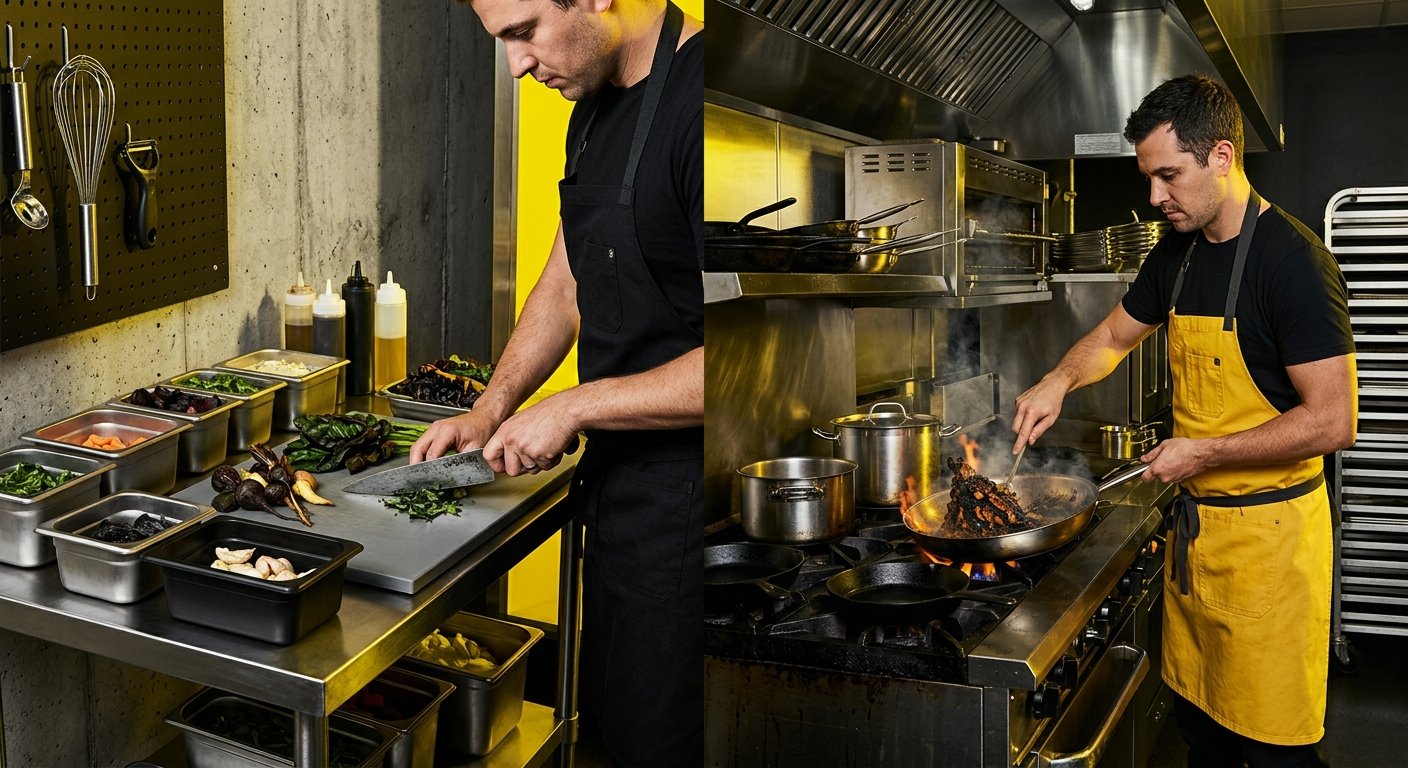
A prep cook and a line cook are not the same job. They happen in the same kitchen, often to the same people at different points in their career, but the work is different — the hours, the pressure, the skill set, and what a good day looks like.
Here’s how they actually break down.
What a prep cook does
Prep runs before service. The shift starts in the morning or early afternoon, and the job is to build everything the line will need to function.
That means breaking down proteins, portioning to spec, making sauces and stocks, washing and cutting produce, filling hotel pans, labeling and dating everything, and setting up mise en place for each station. The goal is to walk out of the kitchen before service starts having left it ready.
The pace is different from service. It’s volume and precision rather than speed and reaction. You’re working against a prep list, not a ticket printer. You can think. You can fix a mistake without it affecting twelve other dishes in the window.
Prep cooks are often newer to the industry, or experienced cooks who prefer a more predictable schedule. The skill floor is real — poor prep directly causes service failures — but the pressure profile is lower than the line.
What a line cook does
A line cook works the service. When guests are seated and orders are coming in, the line cook is executing dishes in real time from their station.
Depending on the kitchen, a line cook might run sauté, grill, fryer, cold station, or pass. In smaller kitchens, they cover multiple stations at once. The work demands speed, consistency, and the ability to hold multiple orders in your head while working with fire, knives, and hot equipment.
The margin for error is small. A late ticket slows the window. An overcooked protein means an eighty-six or a refire. A disorganized station means reaching for the wrong thing at the worst time.
Line cooks typically work the service shift — late afternoon through late night — which means late hours, physical intensity, and an adrenaline-based rhythm that either suits you or destroys you over time.
The key differences
Time of day. Prep runs days. Line runs evenings and nights.
Pressure type. Prep is deadline-based — you have X hours to produce Y output. Line is reactive — you’re responding to incoming orders in real time.
Skills in focus. Prep prizes knife work, organization, and consistency at volume. Line prizes speed, composure under pressure, and the ability to cook multiple things simultaneously.
Physical toll. Both are hard on the body. Line is harder in the short term; prep can accumulate over years in the same repetitive motions.
How you move from one to the other
Most cooks start on prep. It’s the right place to learn the fundamentals — knife skills, station discipline, how a kitchen organizes itself — before adding the service pressure of the line.
The move to line cook is the most common internal promotion in a kitchen. You’re not just learning new techniques; you’re learning to work differently. Faster. With more going on. Without stopping to think.
Some cooks prefer prep and stay there. It’s a real career path, not a consolation prize — a great prep cook is one of the most valuable people in a kitchen and experienced kitchen managers know it.
Others spend years building toward the line, then spend years on it, then eventually want out of the service hours and move back.
Which role is right for you
If you want regular hours, a slower pace, and work where precision pays off directly — prep is worth considering.
If you want the intensity of service, want to be in the middle of it when things are moving fast, and can tolerate late nights and physical demand — the line is where that is.
Neither is a step below the other. They’re different jobs for different people. The kitchen needs both to function.