
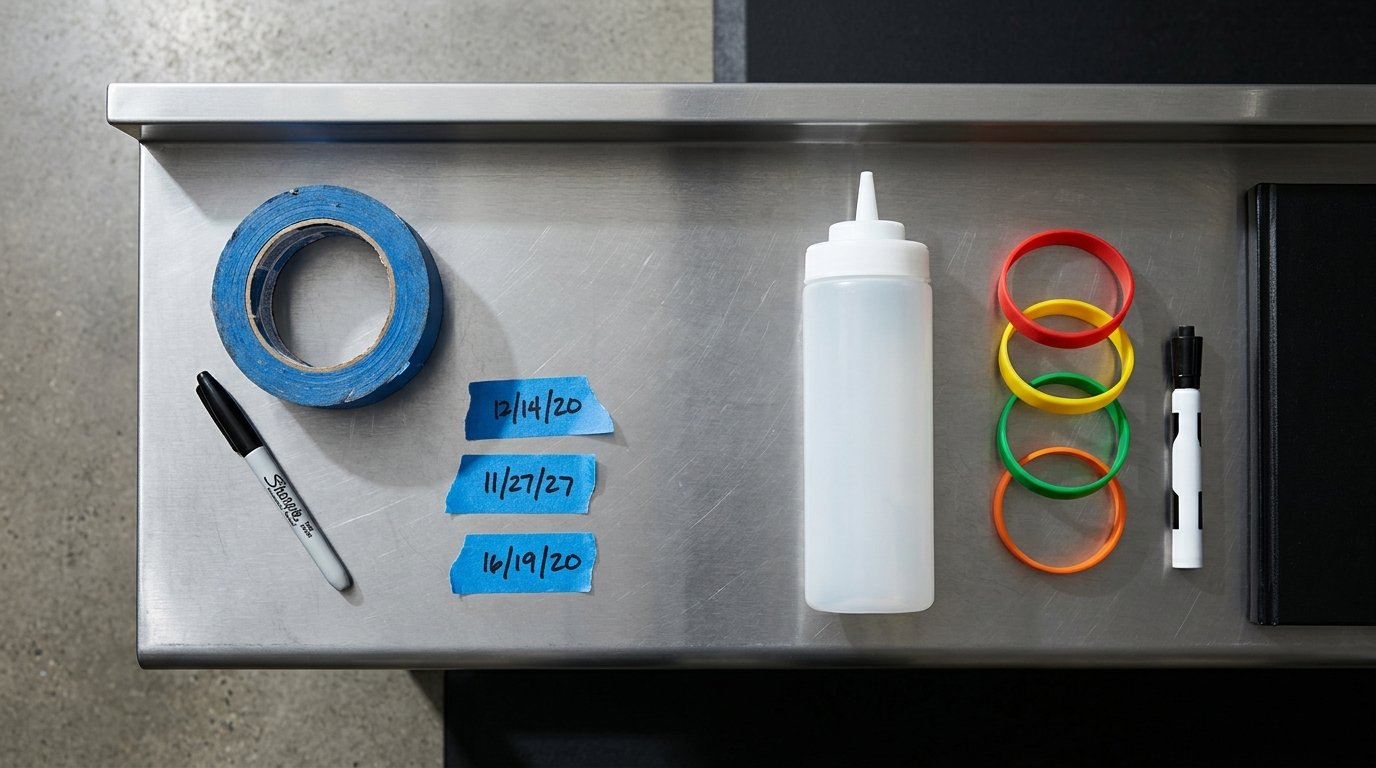
A mid-sized restaurant running 20 squeeze bottles on tape spends $280–$420 per year on tape alone, plus 40–60 hours of labour re-labelling at the start of each shift. A silicone-band system for the same 20 bottles is a one-time $160–$220 outlay with effectively zero per-shift labour. Break-even lands at month three. After 12 months, tape costs 2–3x what silicone bands do once labour is counted. The math no one shows you is the labour math.
The visible cost: tape itself
A standard roll of blue painter’s tape or masking tape, the kind most kitchens use for dating and labelling, costs $4–$8 at commercial volume. A working line burns through one to two rolls a month — more if the kitchen uses tape for both squeeze bottles and prep-container FIFO. Call it 15–20 rolls a year for a mid-sized restaurant. That’s $60–$160 in tape alone. Manageable. Not the real cost.
The real cost is what the tape doesn’t do.
The invisible cost: labour
A 20-squeeze-bottle line takes a prep cook roughly 10–15 minutes every shift to re-tape after the previous service’s labels have lifted, curled, or peeled in the commercial dishwasher. At a burdened labour rate of $22–$28 per hour (per US Bureau of Labor Statistics for food prep workers, plus benefits and payroll burden), that’s $3.70–$7.00 per shift in labour, just on relabelling.
Run that across 300 service days a year — a modest estimate for a full-service restaurant — and you’re at $1,100–$2,100 in labour annually. That’s before you count the time spent scrubbing glue residue off bottles that ran through the dishwasher with their tape half-peeled, or the time spent guessing at a smudged sauce name because the Sharpie ran under steam.
Most kitchens don’t tally this because it’s spread across the shift. A 15-minute tape pass looks like “setup” on a prep list. It doesn’t get costed as a line item. But it’s the single biggest cost in the tape system.
The rework cost: what tape costs when it fails
Tape that fails at the wrong moment costs more than tape that works. Two failure modes drive rework cost:
- A label peeling mid-service means a line cook grabs the wrong bottle on a fire. Best case: the pass sees it before it goes out. Worst case: a plated-wrong ticket, a comp, or an allergen incident. Allergen mislabelling costs are not bounded — the FDA Food Code 2022 treats undeclared allergens as a critical violation, and one customer incident can close a kitchen for days.
- Tape adhesive residue on bottles forces scrubbing, which adds 1–2 minutes per bottle to the dishpit pass. Twenty bottles a night is another 30–40 minutes of labour daily. Nobody budgets for this. It just happens.
Rough allocation: 5–10 hours a month of rework labour directly attributable to tape failure modes. At the same burdened rate, that’s another $1,300–$3,300 per year.
Total tape-system cost, 12 months, 20 bottles: $2,500–$5,600 depending on volume, incident frequency, and how honestly the kitchen costs prep labour.
The silicone-band alternative
A food-grade silicone band compliant with FDA 21 CFR 177.2600 costs roughly $8–$11 per band at commercial volume. A 20-bottle line needs 20 bands, plus a handful of spares — call it 25 bands, or $200–$275 upfront. The bands survive the commercial dishwasher (82°C / 180°F final rinse per NSF/ANSI 3) without lifting, peeling, or leaving residue. Good bands hit 500+ cycles before visible wear. At one cycle per day, that’s 18+ months of service before replacement.
Writable silicone bands take a dry-erase marker in 5 seconds — faster than tearing and hand-writing tape. Colour-coding by station or allergen is built into the colour of the band itself, not a separate Sharpie step. Re-labelling for the next service means a quick wipe or a dishwasher pass. No residue. No scrubbing. No rework.
Annualised: $200–$275 in bands + roughly 5–10 hours of labour across the year (because something always has to be re-marked). At the same burdened rate, that’s $110–$280 in labour. Total silicone-band system cost, 12 months, 20 bottles: $310–$555.
Break-even and 12-month delta
Break-even between tape and silicone bands lands around month three — the upfront $200 in bands is recouped by the labour savings inside one quarter. After 12 months, tape costs 2–3x what silicone bands do when labour is included in the math. For a 40-bottle or 60-bottle operation, the multiplier gets worse because tape labour scales linearly and silicone-band labour doesn’t.
The only operation where tape wins on cost is a single-bottle back-of-house (a home kitchen, a small cafe with one sauce bottle total). Anything larger, silicone bands win on a 12-month view — often before the first quarter closes.
What this changes on the prep list
Kitchens that have made the switch report the same pattern: the 15-minute morning tape pass disappears, replaced by a 30-second band check. The squeeze-bottle section of the prep list gets shorter. The dishpit stops scrubbing glue. The line stops reading smudged Sharpie.
None of that shows up on a cost spreadsheet unless you’re looking for it. It shows up on the shift. Which is the only place it needs to.
The wedge, said quietly
Kitchen Bandits builds silicone bands for exactly this math — writable food-grade silicone, rated to 450°F (232°C), FDA 21 CFR 177.2600 compliant, engineered to clear a commercial dishwasher without residue. The point isn’t that tape is wrong. The point is that tape has a cost nobody prices honestly. Price it once at 12 months all-in and the system picks itself.