
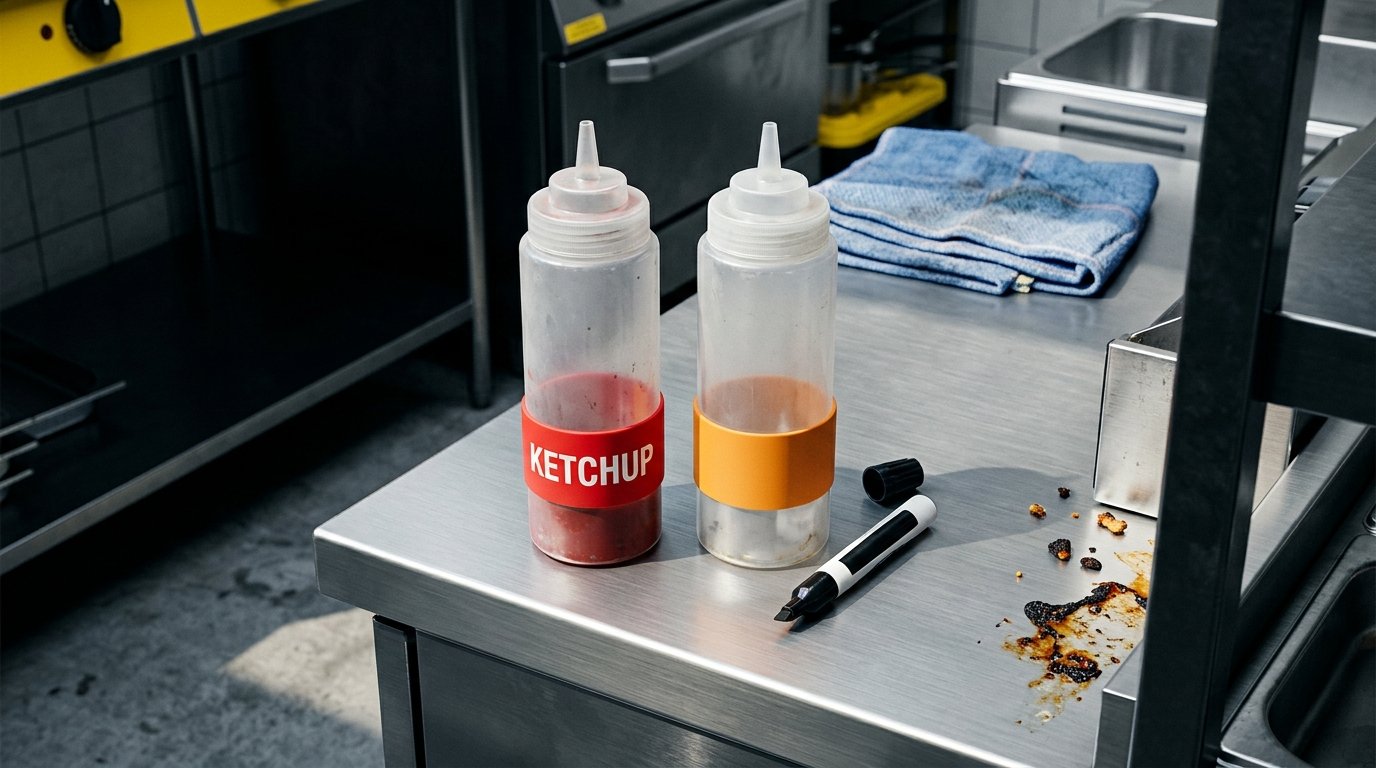
Pre-printed silicone bands and writable silicone labels solve two different problems. Pre-printed bands are a permanent label — ketchup stays ketchup, purple stays allergen, the band never needs updating. Writable labels are a re-labelling system — aioli on Monday, chipotle mayo on Wednesday, compound butter on Friday. Most working lines end up running both. The mistake is buying one and asking it to do the other’s job.
What each one is built for
A pre-printed silicone band is a food-grade silicone loop with text or graphics baked into the surface during manufacture. The print is permanent — it can’t be wiped, scratched, or washed off. That’s its whole value. Line cooks can read “KETCHUP” from three feet away, in low light, through steam, without squinting. The band goes on the bottle on day one and stays there for the life of the bottle.
A writable silicone band is the same base material — food-grade silicone, FDA 21 CFR 177.2600 compliant — with a matte or satin surface finish that accepts a dry-erase or wet-erase marker. The band is blank. The cook writes the contents, the date, and any other marking the kitchen needs, wipes clean in the commercial dishwasher, and re-labels for the next shift.
Same material. Different job.
When pre-printed is the right answer
Pre-printed bands win in three situations. First, standing allergen and colour-coding schemes — a purple band reading “ALLERGEN” on an allergen-prep squeeze bottle is easier to read and harder to mistake than a hand-written note. Second, FIFO-critical long-life items where the contents don’t change — vinegar bottles, neutral oil, soy sauce. Third, high-volume identical workstations where the back-of-house wants every line looking the same — a twenty-cover station with six standard sauces gets there faster with pre-printed bands than writable ones.
The trade-off is inventory. A kitchen that adds one seasonal sauce a month with pre-printed only ends up with a drawer of unused bands and a hand-written note taped to the bottle anyway. Catalogue breadth matters — if the sauce you need isn’t in the supplier’s pre-printed range, you’re back to tape.
When writable is the right answer
Writable wins everywhere the menu moves. Line sauces that change by service, prep-kitchen squeeze bottles that rotate through different applications, compound butters and flavoured oils that get made in small batches, short-life items that need a date and an initials. The band takes a dry-erase marker, holds through service under heat and the occasional splatter, and wipes clean in the commercial dishwasher without residue.
The trade-off is legibility and speed. A hand-written “AIOLI 04/22” is never as crisp as a pre-printed “AIOLI,” and a new line cook unfamiliar with the station’s handwriting will need a beat to read it. For most working kitchens, that beat is acceptable because the alternative — running out of the right band, or running ten versions of the same band — costs more.
FIFO and the case for running both
FIFO (first in, first out) is where the division gets clearest. The container the sauce lives in — a 1/6 Cambro in the walk-in, a deli container on the prep shelf — should be marked with the contents and the date every time it’s made. That’s writable. The squeeze bottle that dispenses that sauce onto the plate during service, when the contents change every day, should also be writable. But the colour-coded purple allergen bin on the top shelf of the walk-in, which is always allergen and never anything else, should be pre-printed — so there’s no world where someone hand-writes a non-allergen label onto an allergen bin because they grabbed a blank.
A working kitchen ends up with writable bands on the moving parts and pre-printed bands on the fixed parts. That’s not a compromise. That’s the design.
What both have to survive
Whatever you buy, the band has to hold up in a commercial dishwasher. Commercial sanitising units run at 82°C (180°F) per NSF/ANSI 3 with high-pressure spray arms and alkaline detergent. Adhesive-backed labels — paper, vinyl, laminated tape — fail at that spec, some within a week, some within a month. Silicone bands have no adhesive to fail. A band compliant with FDA 21 CFR 177.2600 handles the full commercial rinse cycle and is rated to 450°F (232°C), which covers the dishwasher, the oven rail, and every hot surface a squeeze bottle will ever touch.
For writable bands specifically, the dishwasher also has to release the marker. A good writable silicone surface gives up dry-erase ink cleanly in one commercial pass. A cheap writable silicone — usually a coated or surface-treated product rather than solid food-grade silicone — starts ghosting after ten to twenty cycles. By cycle fifty the band is visibly shadowed with faint outlines of “AIOLI” and “SRIRACHA” from three weeks ago. It’s still food-safe. It’s just stopped being writable.
How to tell the difference when buying
Four things separate the right band from the wrong one, whichever type you’re after. The material is solid food-grade silicone, not coated or blended — ask for the FDA 21 CFR 177.2600 reference. The temperature rating is 450°F / 232°C. The surface finish matches the job: glossy is fine for pre-printed, matte or satin is required for writable. And the product page shows the band doing the job, not just sitting on a white background — a writable page that won’t show the band written on and wiped clean is selling you a product philosophy that doesn’t include writable as a first-class feature.
The wedge, said quietly
Pre-printed-first is a catalogue business — you win by having the right sauce name in stock when the customer needs it. Writable-first is a system business — you win by making one band do many jobs over many shifts. Kitchen Bandits builds writable-first because most professional lines change more than their catalogue stays the same. The bands take dry-erase, hold through service, release in commercial rinse, and come in the colours the kitchen’s allergen and FIFO scheme already uses. Pre-printed has a place on the fixed containers. Writable belongs on the squeeze bottles.