
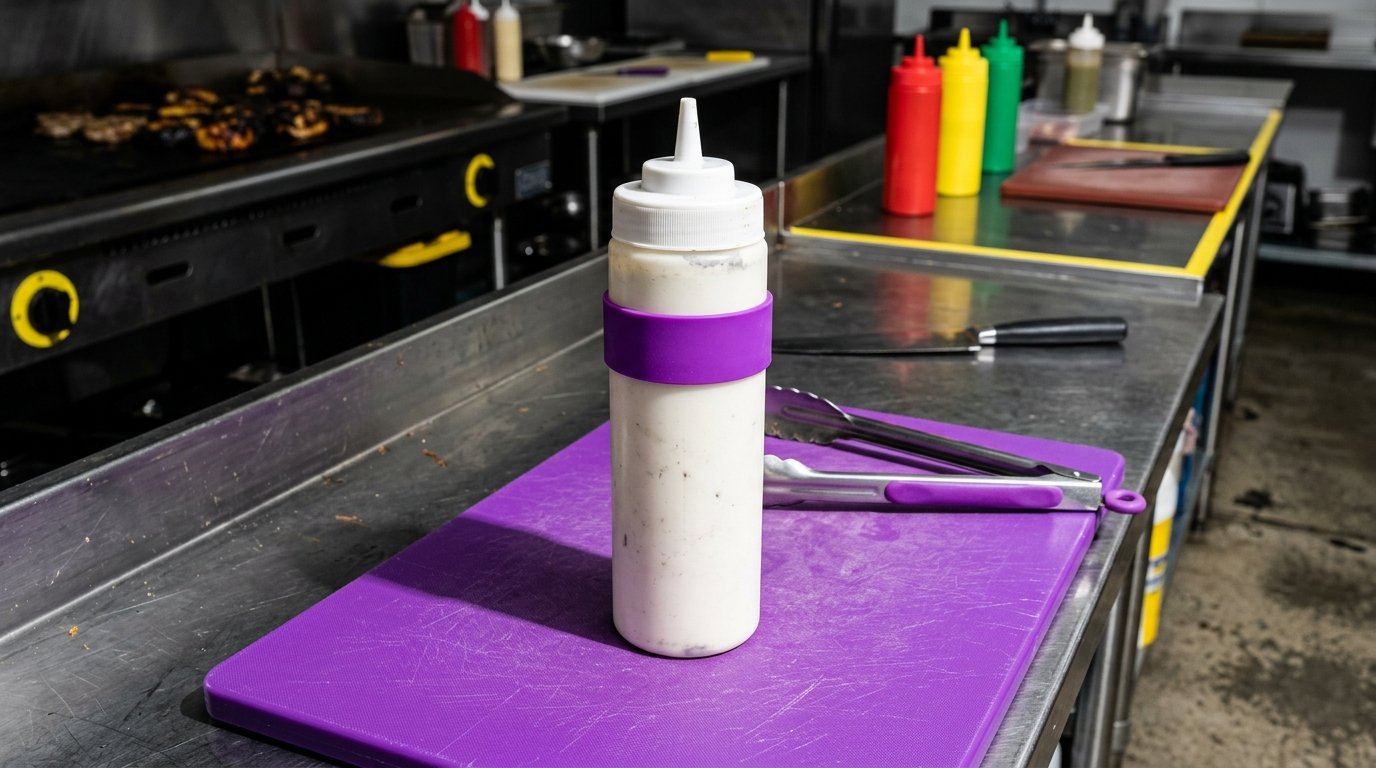
A purple allergen band is a food-grade silicone label in the industry-standard allergen colour, used to flag squeeze bottles containing or having contained one of the nine major allergens. The system works when purple is exclusive — only allergen-contact items, every allergen-contact item — and when it’s paired with physical segregation, written procedure, and a label that survives the commercial dishwasher so the visual cue doesn’t fade mid-week. That combination prevents the most common source of allergen cross-contact in squeeze-bottle prep: a bottle grabbed in a rush because nobody could tell at a glance what was inside.

Why purple, and why it’s not negotiable

Colour-coding in professional kitchens works on one principle: one colour, one meaning, every shift, every station. Purple became the allergen-safe colour because it didn’t overlap with any other routine kitchen colour-coding — red for raw meat, yellow for poultry, green for vegetables, blue for fish or seafood, white for dairy or allergen-free. Purple was the one colour left that wasn’t already signalling something else.

The value is cognitive. A line cook moving fast doesn’t read labels on a fire — the cook grabs the bottle that matches the task visually. If allergen items live under a distinct colour that appears nowhere else in the kitchen, the wrong grab becomes visible before it happens. A non-purple bottle on the allergen station or a purple bottle on the general prep station is a signal that something is out of place.

That only holds if the colour is strictly exclusive. A kitchen that uses purple for “allergen” on one station and “house special” on another has defeated the system.

The nine major allergens the system has to cover

Per FDA’s Food Allergen Labeling and Consumer Protection Act (FALCPA), as amended by the FASTER Act of 2021, the nine major allergens in the US are: milk, eggs, fish, shellfish, tree nuts, peanuts, wheat, soybeans, and sesame. The EU and AU lists overlap substantially but add a few more (mustard, celery, lupin, sulfites above 10ppm).

In a squeeze-bottle context, the most common allergen-carrying sauces are:

  • Aiolis and mayo-based dressings (egg)
  • Béarnaise, hollandaise, and derivatives (egg, dairy)
  • Tahini-based sauces (sesame)
  • Peanut-based sauces (peanut)
  • Soy-based glazes and dressings (soy, wheat if soy sauce contains wheat)
  • Dairy crema, ranch, and similar (milk)
  • Fish sauce-containing dressings (fish)

Any squeeze bottle holding one of these gets a purple band. Any squeeze bottle that has held one of these gets a purple band until it’s been cleaned to a verified allergen-free state — and in most kitchens, it’s simpler to retire the bottle to permanent allergen-only duty than to try to move it back.

What the band has to do beyond being purple

A purple-coloured label that fades, peels, or lifts mid-service is worse than no purple at all, because the visual cue disappears without the underlying allergen going anywhere. Three requirements:

  1. Colour stability. The purple has to stay purple through dishwasher cycles, heat, and UV exposure. Food-grade silicone compliant with FDA 21 CFR 177.2600 and manufactured with proper colour pigment holds its colour across hundreds of cycles. Cheap silicone or vinyl starts drifting toward grey-purple or pink-purple after a month of commercial rinse.

  2. Legibility. Writable purple bands let the cook add the specific allergen — “CONTAINS EGG,” “CONTAINS PEANUT” — which matters when an allergen guest asks exactly what’s in the sauce. The band surface has to take a dry-erase or wet-erase marker and hold it through service.

  3. Survivability. The band has to clear the commercial sanitising rinse at 82°C (180°F) per NSF/ANSI 3, alkaline detergent, and high-pressure spray without peeling, lifting, or leaving residue. Adhesive-backed purple stickers fail this. Silicone bands don’t have adhesive to fail.

Food-grade silicone bands rated to 450°F (232°C) also survive the oven rail and hot-pass work — which matters because some allergen prep happens in warm zones, not cold ones.

Physical segregation: the other half

Colour-coding flags the bottle. Physical segregation prevents the cross-contact. A complete system includes:

  • Dedicated allergen prep station — separate cutting board (purple), separate knives (purple-handled), separate tongs, separate whisks. Nothing crosses between allergen and non-allergen prep.
  • Dedicated squeeze bottles — an allergen bottle stays an allergen bottle for life. Re-used general-prep bottles carry residual risk even after washing.
  • Physical separation in the walk-in — allergen bottles live on a dedicated shelf or section, ideally below non-allergen items so drips can’t contaminate downward.
  • Hand-washing between stations — every time a cook moves from allergen prep to general prep, hands wash, gloves change.

ServSafe guidance treats colour-coding as a visual reinforcement of physical segregation, not a substitute for it. A purple band on a bottle that lives in the general prep station doesn’t make the bottle allergen-safe. It makes the system internally inconsistent.

Written procedure and staff training

A kitchen health inspector looking at an allergen programme asks for three things: the written SOP, the training log, and the physical evidence. The SOP documents which colour means what, which stations handle which allergens, who’s authorised to prep allergen orders, and how cross-contact incidents are reported. Training log proves every cook has read and signed the SOP. Physical evidence — purple bands on the right bottles, colour-coded tools at the right stations — shows it’s actually running.

The purple band is the most visible artefact of the programme. But it’s only compliance-valid if the SOP names it and the training explains it.

Common failure modes

Three ways purple allergen systems break down in practice:

  1. Colour drift. The kitchen starts using purple for allergen. Six months in, someone orders a purple label roll for a different use because “we have purple already.” The colour is no longer exclusive. Fix: write into the SOP that purple is reserved for allergen only, and audit new supplies against the SOP.

  2. Band wear. The purple fades. The writing smudges. The bottle is still handling allergen prep, but the visual cue has degraded. Fix: replace bands on a schedule (quarterly for heavy-use stations) and build a visual check into the opening SOP.

  3. Cross-station bleeding. An allergen bottle gets borrowed to the general station “just this once.” Fix: hard rule, allergen equipment never leaves the allergen station, enforced by station layout and supervisor habit.

Where this sits in the broader kitchen system

A purple allergen band is a single component of a larger allergen-management posture. It works when the rest of the posture is in place: SOP, training, physical segregation, dedicated equipment, documented incident response. It doesn’t work in isolation — a purple band on a single bottle in a kitchen without any other allergen infrastructure is cosmetic.

But it’s the most visible and most-audited piece. The purple band is the part the customer, the inspector, and the new hire all see first. When it’s right, the rest of the system gets the benefit of the doubt. When it’s wrong, the rest of the system gets questioned.

The wedge, said quietly

Kitchen Bandits makes purple allergen bands in food-grade silicone (FDA 21 CFR 177.2600), rated to 450°F (232°C), writable, and dishwasher-stable — the band stays the same purple for the life of the bottle. A colour-stable, legible, dishwasher-surviving band is the physical requirement for any allergen system worth writing down. Everything else is procedure, training, and kitchen layout.