
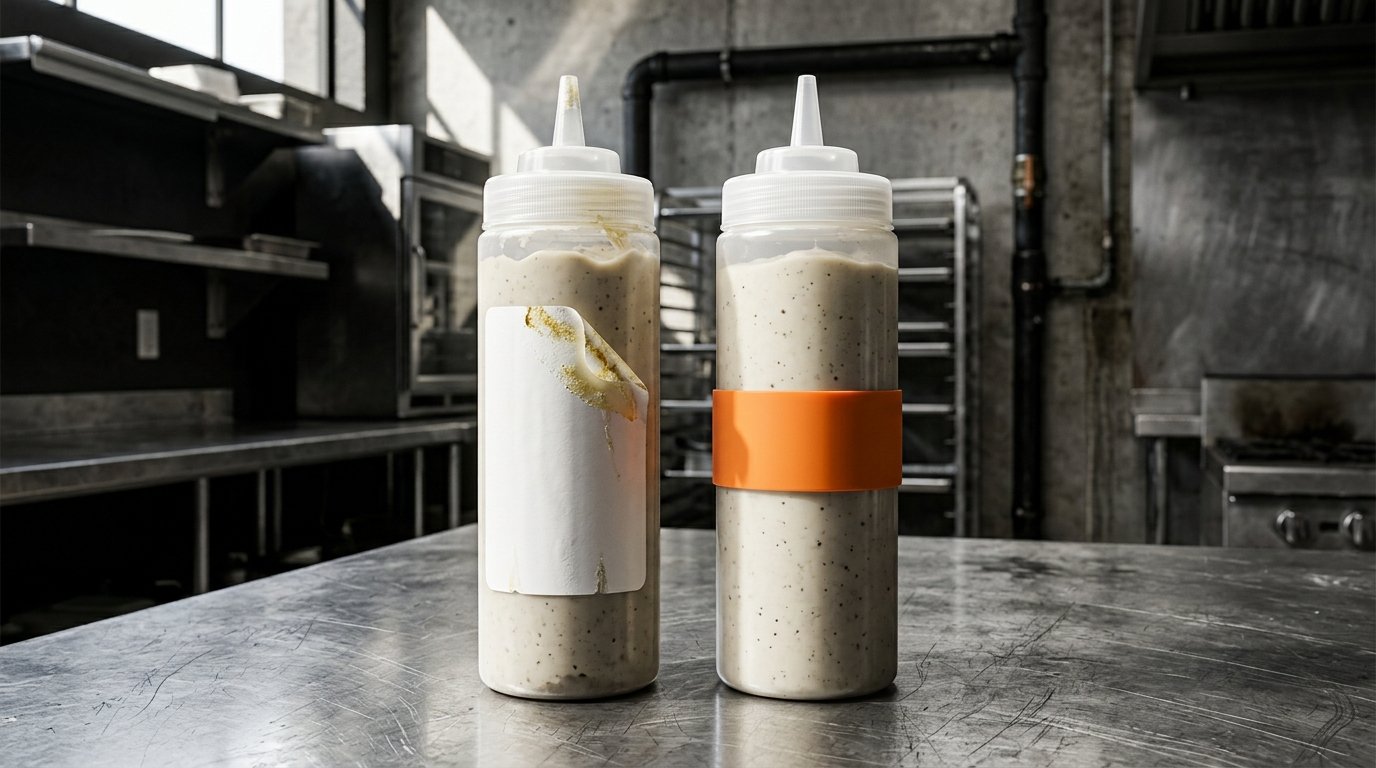
Silicone bottle bands and vinyl labels both claim to solve the same problem — reusable, legible labelling on squeeze bottles and prep containers that go through a commercial dishwasher. In a real working kitchen they don’t compete on even terms. Silicone bands survive 500+ cycles without adhesive failure or residue. Vinyl labels start peeling between 20 and 100 cycles, leaving glue residue that has to be scrubbed off. The per-unit price flips once the twelve-month cost is counted.
The material difference
A vinyl label is a flexible plastic film with a pressure-sensitive adhesive backing. The film itself holds up reasonably well to heat and moisture — the failure mode is almost always the adhesive, not the vinyl. Under a commercial sanitising rinse at 82°C (180°F) per NSF/ANSI 3, the adhesive softens, the alkaline detergent attacks the glue chemistry, and the high-pressure spray arm finds and lifts any weak edge.
A silicone band is a loop of food-grade silicone polymer, no adhesive involved. It holds to the bottle by elastic tension and friction. Food-grade silicone compliant with FDA 21 CFR 177.2600 is rated for repeated food contact, continuous use up to 230°C (450°F) in the best-grade products, and is chemically inert to the detergents used in commercial warewashing.
The whole comparison starts from this: vinyl relies on glue, silicone doesn’t. Once that’s said, most of the rest follows.
Dishwasher survival, by the numbers
Commercial pass-through and flight dishwashers operate on a tight spec: pre-rinse, wash with alkaline detergent at pH 11–13, sanitising rinse at 82°C minimum, spray arms at 20–40 PSI. A label or band has to hold across all four stages.
Empirical patterns from kitchens running both systems:
- Paper labels fail on cycle one.
- Standard vinyl stickers start lifting at the corners around cycle 20–40. Full failure (label off the bottle) usually hits by cycle 50–80.
- Industrial-grade vinyl (Avery Durable, 3M commercial series) stretches that to 80–150 cycles before visible lift. But the failure mode is the same — edges first, then the whole label.
- Laminated tape (Brother P-Touch TZe and equivalents) survives 100–200 cycles, better than vinyl because the laminated top layer protects the print and the adhesive is tougher. But once it starts to fail, it fails all at once.
- Food-grade silicone bands (FDA 21 CFR 177.2600, rated to 450°F / 232°C) run 500+ cycles with no adhesive failure. Typical retirement driver is visible wear on colour, not dishwasher failure.
At one dishwasher pass per day, that’s:
- Vinyl: replace every 1–3 months
- Laminated tape: replace every 3–6 months
- Silicone band: replace every 18+ months
The residue problem
Vinyl’s other cost is the residue. When a vinyl label peels, the adhesive rarely comes with it cleanly. What’s left on the bottle is a yellowed, slightly tacky patch that resists rinse water and has to be scrubbed off with a scouring pad or dissolved with solvent. In a busy dishpit, that’s an extra 1–2 minutes per bottle, every time a label comes off.
Twenty bottles a night, five days a week, that’s another 30–40 minutes of dishpit labour daily. Nobody lines it up against the cost of the label, but it’s a real line on the P&L.
Silicone bands have nothing to leave behind. The band comes off because the cook pulls it off (for cleaning or replacement), and nothing stays on the bottle.
Colour stability
Vinyl labels are printed. The print can be durable (solvent-resistant inks, UV-cured coatings) or it can fade. Premium commercial vinyl is pretty good here. Consumer-grade vinyl fades visibly in eight to twelve weeks of commercial wash cycles, with reds going pink first, yellows greying out, and black staying best.
Silicone bands aren’t printed — the colour is integral to the silicone itself, set during manufacture. A pigmented food-grade silicone band holds its colour for the life of the band. What you see on day one is what you see on day 500.
This matters for allergen and FIFO colour-coding systems, where colour drift undermines the whole point of the programme.
Cost: day one vs year one
On day one, vinyl wins.
- Vinyl label, commercial grade: $0.30–$0.80 per label
- Silicone band: $8–$11 per band
For a 20-bottle line, that’s $6–$16 in vinyl versus $160–$220 in silicone. On paper, vinyl is 10–20x cheaper.
Year one tells a different story. Assume one dishwasher cycle per day, 300 service days, 20 bottles:
- Vinyl system: labels replaced every 60 days = 100+ labels per bottle per year = 2,000 labels across the line. At $0.50 each, $1,000 in label material. Add residue-scrubbing labour at 30–40 min/day × 300 days × $22–$28/hr = roughly $3,300–$5,600. Add re-labelling labour at 10 min/day × 300 days = roughly $1,100–$1,400. Total: $5,400–$8,000.
- Silicone band system: $160–$220 upfront. Effectively zero residue labour. Re-labelling via dry-erase on writable bands is ~30 seconds per bottle per shift, ~10 min across the line = roughly $1,100–$1,400 a year. Total: $1,260–$1,620.
Year-one ratio: vinyl costs 3–6x what silicone bands do once labour and residue are counted honestly. The multiplier gets worse every subsequent year because silicone bands don’t get replaced and vinyl does.
Where vinyl still wins
Vinyl labels have two legitimate jobs in a commercial kitchen:
- Permanent, long-term labelling on surfaces that never go through a dishwasher — walk-in shelf labels, procedure cards stuck to the inside of a locker, allergen warnings on the back of a prep station. Once vinyl doesn’t have to survive rinse, it survives indefinitely.
- Branded / graphic labels where the design complexity exceeds what a silicone band can carry — logo stickers, regulatory compliance labels with barcodes and detailed text. A silicone band is a loop of colour with minimal printing; it’s not going to replace a full-graphic equipment label.
For squeeze bottles, prep containers, and anything that cycles through the dishwasher, silicone bands win consistently after the first month.
The buying rule
The rule most commercial kitchens settle on, after running both: vinyl for static surfaces, silicone for cycling surfaces. Don’t buy vinyl for anything that’s going in a dishwasher. Don’t buy silicone for anything that isn’t. The per-year math tells you this, but it takes most kitchens a year of vinyl failure and dishpit residue to believe it.
The wedge, said quietly
Kitchen Bandits builds silicone bands for the cycling-surface job — food-grade silicone (FDA 21 CFR 177.2600), rated to 450°F (232°C), writable with dry-erase, pigmented colours that don’t drift, engineered for 500+ commercial dishwasher cycles. Vinyl stays on the walk-in shelf. Silicone goes on the squeeze bottle. The two systems coexist. The cost math settles itself once the kitchen stops pricing labels by the unit and starts pricing them by the year.