
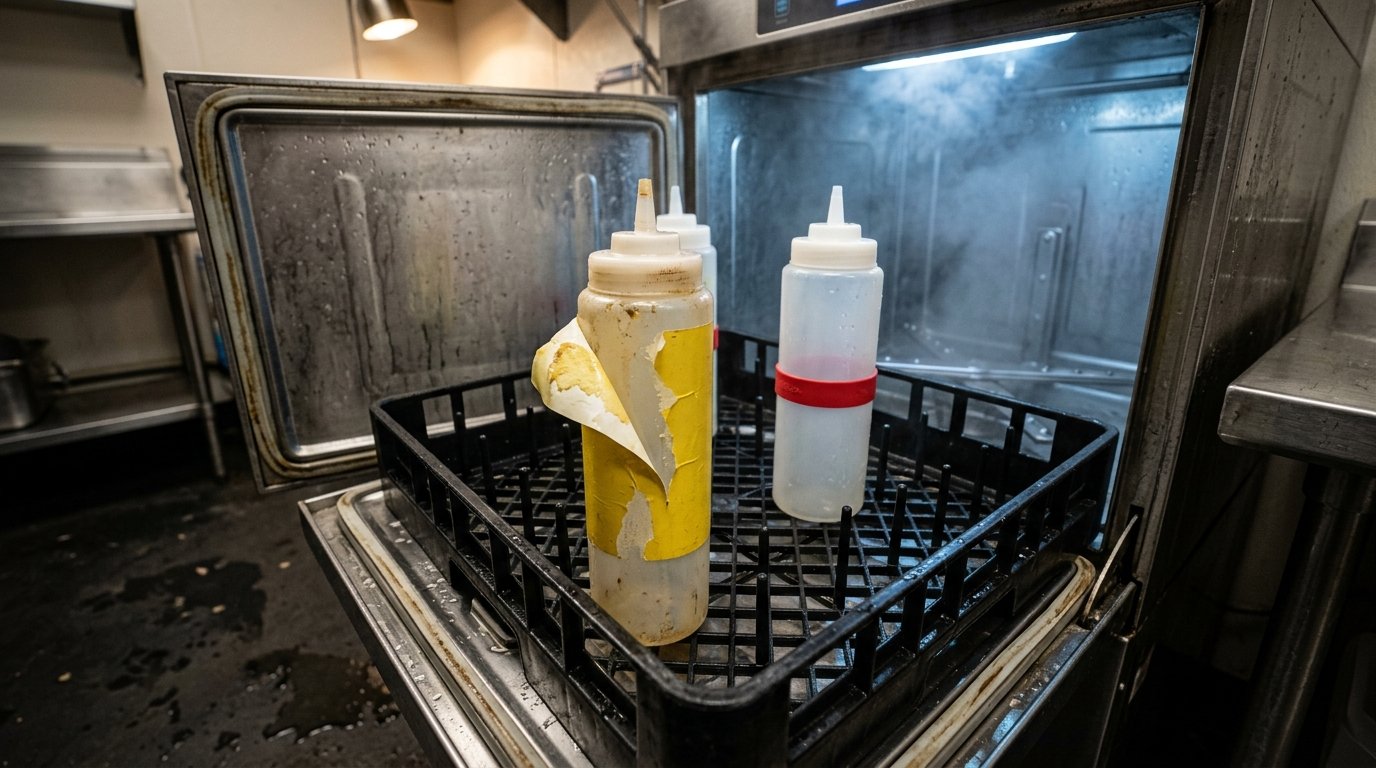
Dishwasher-safe labels peel in commercial kitchens because the rating was written for home appliances. Home units top out around 65–75°C on the rinse cycle. Commercial sanitising units have to hit 82°C (180°F) per NSF/ANSI 3 and run high-pressure spray arms with alkaline detergent. Most adhesive-backed labels can handle one of those three variables. Very few handle all three, week after week.

The label tested on your countertop failed the test that matters

“Dishwasher-safe” on a product page is a marketing claim, not a compliance rating. There’s no single standard it maps to. In practice it means the label survived a few cycles on a home dishwasher — probably on the top rack, probably with gentle detergent, probably for long enough to write a positive review.

A commercial pass-through or flight unit works differently. Final rinse hits 82°C or higher. Detergent is strongly alkaline, usually pH 11–13, engineered to break down grease fast. Spray arms push water at 20–40 PSI depending on model. That combination is brutal on adhesive. The glue softens at temperature, the alkaline chemistry attacks the adhesive polymers, and the high-pressure jet peels the edge the moment a weak spot appears.

Why each label type fails (and when)

Paper labels. Dissolve or tear on the first cycle. Nobody’s claiming these are reusable, but restaurants still use them for FIFO dating and then watch them float off the bottle mid-wash. Day-dots work fine for containers that get hand-wiped. They’re not built for squeeze bottles going through the dishwasher.

Vinyl stickers. The vinyl itself is fine. The adhesive isn’t. Edges lift first — usually at the top of the label where the spray arm hits. Within 20–40 cycles a label that looked bulletproof in week one is curling off in pieces. Residue left behind is its own problem. Alkaline detergent softens the glue but doesn’t fully release it, so you end up scrubbing gummy patches off squeeze bottles with a scouring pad.

Laminated tape (Brother P-Touch, Dymo, similar). Genuinely better than vinyl for commercial rinse survival. The laminated top layer protects the print, and the adhesive is tougher. But the failure pattern is the same — corners lift first, usually after 50–100 cycles, and once air gets under the tape it accelerates. When the tape fails it tends to fail completely, not gradually. One shift the label is fine. Next shift it’s gone and so is the one underneath it, which you also hadn’t updated.

Writable adhesive labels (Avery Durable, Name Bubbles reusable). Better than generic vinyl because they’re engineered for repeat washing. Still adhesive-backed, so the same failure mode applies — just slower. Good for containers that get hand-washed between uses. Not the right tool for squeeze bottles that go through a pass-through nightly.

What actually survives — and why

Food-grade silicone bands have no adhesive to fail. That’s the whole story. A band holds to the bottle by friction and elasticity, not glue, so alkaline detergent and 82°C water can do whatever they want and the band stays where it is.

A band that meets FDA 21 CFR 177.2600 for food-contact silicone is rated for continuous food contact and handles the full commercial dishwasher spec — temperature, detergent, pressure. Good silicone bands are also rated to 230°C (450°F), which means they survive oven rails and hot-pass work, not just the dishwasher. Most pass-through units will run a band for 500+ cycles before you see any visible wear. Colour stays true. No residue, no lifting edges, no scrubbing.

When tape still wins

Laminated tape is the right answer for one job: labels that have to stay put forever and be readable from distance. Fridge shelves, HACCP procedure cards, allergen warnings on walk-in doors. A P-Touch TZe strip laminated onto a stainless surface lasts years.

Tape is the wrong answer when the label has to be updated regularly and the surface goes through a dishwasher. That’s squeeze bottles, pan bands, cap labels on prep containers, anything re-labelled shift-to-shift. The pattern to watch for: if your kitchen buys tape in bulk every month, something else should be doing that job.

What kitchens swap to

The swap happens in a specific order. First comes the writable silicone band for squeeze bottles, because that’s where adhesive failure costs the most — wrong bottle during service is a plated-wrong ticket or an allergen mix-up. Next comes the colour-coded band on prep containers for FIFO and allergen management. Tape stays for the long-term, static labelling jobs.

Kitchen Bandits bands are built for the first job: writable silicone that takes dry-erase, survives commercial rinse cycles, and shows up for the next shift without lifting, fading, or leaving glue behind. The rest of the label inventory — the walk-in shelf headers, the procedure cards, the hood chart — can stay on tape. The squeeze bottles don’t have to.