
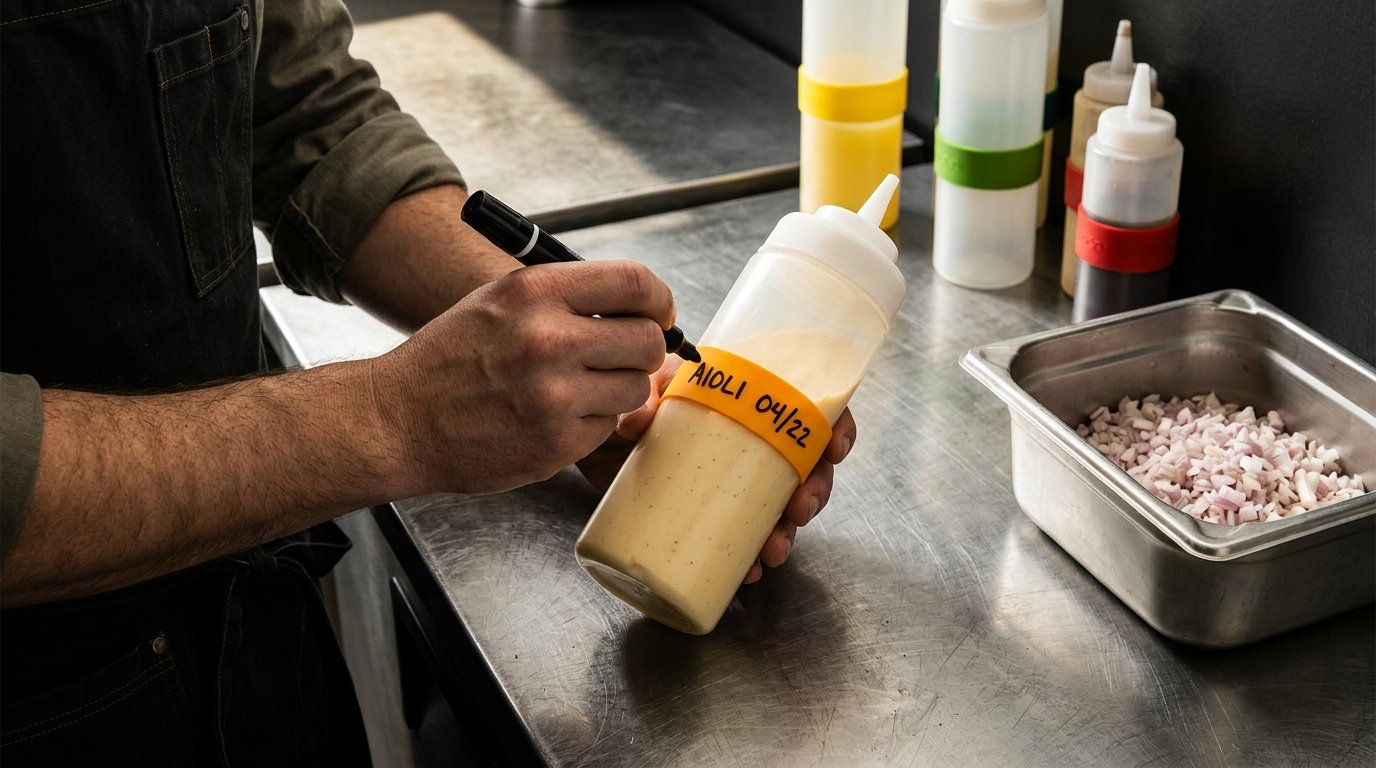
A writable silicone bottle band is a food-grade silicone label that accepts a dry-erase or permanent marker, wipes or washes clean, and can be re-labelled for the next service. To count as writable on a working line, it has to hold ink through service and release it during a commercial dishwasher cycle. Most labels sold as writable only do one of those two jobs.
What “writable” has to do on a working station
Writable is a capability, not a feature. A label that holds a marker but smears the moment you wipe a splash off it isn’t writable in any useful sense — you’ve just burned the label. A label that wipes clean too easily isn’t writable either — the first condiment splatter erases “Sriracha 04/22” and now the sauté cook is guessing.
Working kitchens need three things from a writable band: it has to accept marker cleanly (no ghosting, no beading), hold the ink for at least a full service under heat, grease, and the occasional rag-wipe, and then release it cleanly in a commercial dishwasher so the next shift can re-label it without stripping or soaking.
Dry-erase vs wet-erase vs permanent: what actually holds
Not every marker is right for every surface. On food-grade silicone, dry-erase is the default — it lays down cleanly, survives moderate splatter, and comes off with a damp cloth or a commercial dishwasher pass. Wet-erase (the kind used on restaurant menus) holds harder and survives more accidental contact, but needs a wet wipe or rinse to remove. Permanent marker is a trap. It writes beautifully on silicone. It does not come off in a dishwasher. You’ve just bought a permanent label.
The working answer for most lines is a chisel-tip dry-erase marker in black, with a china marker or silver paint pen as backup for dark-coloured bands where dry-erase disappears.
Why most “writable” labels aren’t
Look at how the label is sold. If the product page says writable but the photos show only pre-printed text, the writable surface is an afterthought. Three patterns show up repeatedly on labels that underdeliver:
- Smooth, glossy silicone. Marker beads and skips. Some ink holds, some slides off within an hour.
- Printed coating on top of silicone. The writable layer is a surface treatment, not the band itself. It scratches, scuffs, and fades after ten wash cycles.
- Silicone blended with cheap fillers. Passes a short dishwasher cycle but deforms, discolours, or starts absorbing grease after a month of service. The marker starts ghosting permanently.
A band that’s actually writable has a matte or satin-finish food-grade silicone surface — enough tooth to grab the ink, smooth enough to release it in a rinse. The silicone itself is the writable surface. Nothing on top of it.
What survives a commercial dishwasher cycle
Commercial dishwashers run hot — the final sanitising rinse has to hit 82°C (180°F) per NSF/ANSI 3 to count as sanitised. That’s water temperature, not air temperature, and it’s hotter than any home appliance runs. A label or band has to handle that temperature plus an alkaline detergent plus high-pressure spray without warping, delaminating, or staining.
Food-grade silicone compliant with FDA 21 CFR 177.2600 will typically hold up through hundreds of cycles. Paper labels, vinyl stickers, and most laminated tapes won’t. Glue-backed labels fail first because the adhesive breaks down at temperature. Vinyl stickers cook around the edges. Laminated tape like Brother P-Touch survives longer but eventually lifts at the corners — usually right when you need it most.
How to spot the difference when buying
When you’re looking at a band and trying to tell whether it’s actually writable for working-kitchen use, three things separate the real from the marketing:
- Surface texture. Matte or satin, not glossy. You should see the finish in the product photography, not just a polished hero shot.
- Temperature rating. Real food-grade silicone bands are rated for at least 230°C (450°F). That covers every oven, pan, steam wand, and dishwasher rinse you’ll put them through.
- Write-erase-write proof. The product page should show the band written on and then wiped clean — ideally both with the same marker and with a photo of it going through a wash cycle. If the whole sell is pre-printed sauce names and writable is a line item in the bullets, it’s a pre-printed band with a writable caveat. Not the other way round.
The wedge, said quietly
Writable-first is a different product philosophy from pre-printed-first. Pre-printed bands are a sauce catalog — useful if your menu never changes. Writable bands are a system — useful if Monday’s aioli becomes Wednesday’s chipotle mayo and Friday’s compound butter. Kitchen Bandits builds writable-first for that reason. The bands take dry-erase, hold through service, and release in the commercial rinse without drama. Everything else is downstream of that.